Tuesday, April 6, 2010

FAQ: Sending Nyamtaivan to the States

RELATED ARTICLE: End of May Update

Who is Nyamtaivan?
Nyamtaivan (pr. Nyim-ta-vin) means "Sunday's Calm." Nyam comes from the Tibetan for Sunday, and taivan means calm.

She is 16 years old with a bright affect, hard-working attitude, and is very mature with a sense of wide-eyed optimism. For the past 4 years, she's received perfect 100% grades in nearly every single class, and she has been the top student at her school since 2007.

Not only does she excel at academics, she's also somewhat of a track and field star and enjoys spending time with her many friends. She's a student leader and a glowing an example of politeness, respect and empathy. To know her is to like her.

Since we began our fund raising efforts, her placement agency New Voice has also taken a shine to her. She's been profiled in the Mongolian newspaper "Unuudur" (Today), and the Mongolian Education Channel has begun a 4-part story on her.
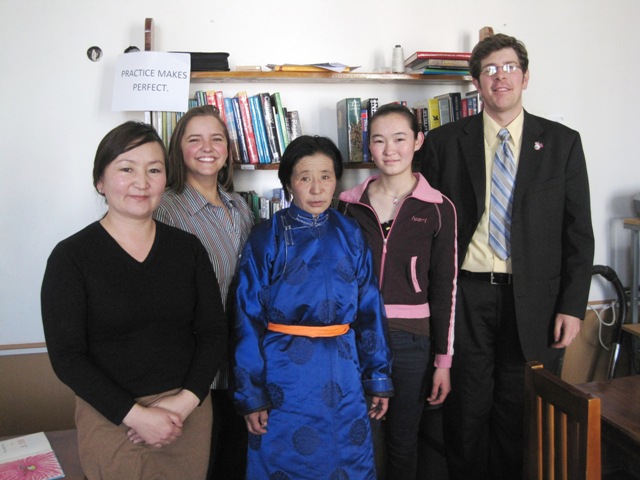
Leslie and Nathan pose in the Bayankhongor American Culture Center
with the province's head methodologist [left], Nyamtaivan's mom [center] and Nyamtaivan.

Why Nyamtaivan?
Nyamtaivan came to Nathan in March 2010 and said she wanted to study abroad, but she didn't have any way to pay for it. She explained that the education system in Mongolia is too limited for her, and if she could study abroad it would help her achieve her goal of being a lawyer and interpreter, so she can put her skills to use changing the Mongolia education system.

We want to help for many reasons.
  1. Motivated, hardest working person we know
  2. Wants to be part of education change in Mongolia
  3. Networking in Mongolia and USA
  4. Comes from a poor family, fewer opportunities
  5. Mom is a single parent
  6. Adult sister has a disability
  1. Nyamtaivan has stood out to the Peace Corps volunteers because of her inquisitive nature, her ability to speak English as well or better than most teachers, and her drive to make a difference. We want to help her study in the states because we know she will do great things for herself, her family, and her country if given the opportunity.

  2. Among the motivators she explained to us is that she wants to be a part of education change in Mongolia. She wants to raise the standards and practices of education for the next generation. To do this, she needs to know how other systems work.

  3. Corruption and nepotism rule the workforce, so we want to give her the ability to work around and through the system by getting a good education, becoming connected with more Americans, and becoming connected with the affluent Mongolians who have studied abroad.

  4. Study abroad programs are only available to rich kids in the capital. She comes from an extremely poor rural family, and the reality here is that hard work is usually not enough. There are no scholarships for people like her to study abroad.

  5. Her mom is a 48 year-old single parent who works as a janitor in a retail section of the market.

  6. Nyamtaivan also has a 25 year-old sister with a mental disability that prevents her from working, so Nyamtaivan helps look after her when she's not at school or studying with friends.
We can't do all the work for her, but we can give her a start.

How will money be raised?
Among the 7 of us Peace Corps volunteers in Bayankhongor, we will each raise $1,143. Divided in this way, our minimum goal of $8,000 can be achieved with a little hard work and from the generosity of friends and family who also want to turn the opportunity into a reality for Nyamtaivan.

Who is in charge of the money?
Leslie and Nathan Chamberlain are in charge of holding and dispersing the money from the Paypal account linked to StudenttotheStates@yahoo.com. They will pay the placement agency New Voice.

What will the money go toward?
The money we raise will be used for her airfare, tuition, visa and placement costs through the agency.

Tuition: $5-6,000 (we'll know exactly how much when she's placed)
Airfare: $1,300 (approximately)
Placement cost: $1,200 ($600 already paid)
Required spending money: $1-2,500 (100-250 for each of the 10 months in USA)
Visa: $131 (Nyamtaivan's mom will pay as her contribution)

What is New Voice?
New Voice is a placement agency that sends over 200 students abroad every year who are required to have a minimal English fluency and be able to pay the fees. They also place university students. To read all about New Voice, you can go to their Web site.

This one of the only possible placement agencies for a child with a rural upbringing. All other placement agencies we saw were only for kids in the capital. Few programs even work with Mongolia. For example, there is to AFS that placed Europeans in our high schools when we were growing up.

What is Paypal?
Paypal is an online merchant service owned by Ebay that can also be used for donations and paying back friends. All you have to do is create a username and password, plug in the numbers of the credit card you want use, and then make the donation. The money will come from your credit card through Paypal, unless your Paypal account already has money in it.

If you already have money in your Paypal account, there are no transaction fees. However, it does charge 2.9% for each credit card transaction for the incredible convenience.

Click here to donate now!


What if I don't want to use a credit card to make a donation?
You can send a check to Leslie and Nathan. Please email nathan_chamberlain@yahoo.com for details.

What do I get if I donate?
Besides the satisfaction of helping a special kid achieve her dreams, we want you to get a little something too, so here are the suggested giving levels.

Help send Nyamtaivan to the States by giving:

$10-24

Added to Nyamtaivan’s email update list*

$25-49

Get a personal email and picture from Nyamtaivan

$50-107

Get a postcard from Nyamtaivan

$108 (1 month’s salary)

Hand-painted Mongolian card

$216 (2 months’ salary)

Hand-painted Mongolian card & 1 felt handicrafts

$324 (3 months’ salary)

Hand-painted Mongolian card & 2 felt handicrafts

$432 (4 months’ salary)

Hand-painted Mongolian card & 3 felt handicrafts

$540 (5 months’ salary)

Hand-painted Mongolian card & 4 felt handicrafts

$1,300 (Est. airfare)

Tax incentives (negotiable)


*All donors will be added to her email

Although the items we ship to you are valuable for many reasons, they do not cost much.

What is the deadline for the fund raising?
Our fund raising goal is to be finished by May 31, 2010. The bill is due in August, so we will continue to raise money until then and even after if we need to. But we are all volunteers and have many other projects we focus on that also demand much of our time in our community. Additionally, most of us will be finishing our Peace Corps service this summer with camps in the countryside throughout June and July, so we won't be available to continue the day-to-day fund raising efforts.

In short, we hope you'll make your donation sooner rather than later, though a few of our friends and family have pledged to help by sending money each month until August, which we encourage and can certainly accommodate as well.


How can I stay in touch with the project as it develops?
If you give money, you'll receive periodic updates from Nyamtaivan on her progress. You can also join the Send Nyamtaivan to the States Facebook group for more pictures, videos and written updates.

Wednesday, March 3, 2010

Board and Committee Trainings: Zavkhan Aimag

NOTE: This entry was written in September 2009. It was subsequently published in March 2010. You can check out the full album of pictures and captions here.
Nathan recounts his trainings trip
After returning from the long summer in UB as a Peace Corps trainer, I had a few days rest, saw my awesome new office, met up with my counterparts including my equally awesome new manager, and then I left town for a week to talk board and committee structure to representatives of our self-help groups in Zavkhan Aimag, the province to our northwest.

For two days, our driver Chuka (pr. CHOke-uh, short for Stone Hero) and I braved the wide open yet very rocky road for the few hundred kilometer trek. Despite the language obstacle (he doesn't speak English) and that he doesn't hear so well, we were great travel companions. We left about 4 hours after the 6am start time he'd set (I was up at 5am), which gave me a little time to work on a good case of whiplash as my body kept going limp vying for spurts of sleep along the jarring terrain.


The gloomy and sleepy drive was uplifted by this unknown family that yelled for me to take their picture.

In Uliastai ("With Birch Trees"), the provincial capital, we met up with the training manager and project manager who had flown in early from UB. After some rest and preparation, our first day of three began with great energy as all participants were on time and checked in before we arrived 5 mins late. This energy carried throughout the entire training all the way to the end of the third day, in no small part due the staff's ice breakers, energizers and engaging games.

Over the course of the three days there and in Bayankhongor this past week, I presented on:
  1. The intrinsic values of being a trustee on a volunteer governing board such as theirs. I adapted materials presented by good pal and fellow PCV Judy Gates, who traveled to other parts of the country with the staff in the previous month. We talked about the virtues of someone who would be elected by their peers for such a position and why the right people are important for the process. We also talked about the skills and qualities the have and will hone during the next year as a trustee.

  2. Conflict resolution and communication techniques, which was rewarding for me. I told them a couple ground rules for resolving disputes like making sure not to accuse the other person (use "I" not "you" language) and to only be concerned with facts. Afterward, I asked them to list their most common problems and then broke them into groups. In those groups they had to come up with solutions. Most involved writing or enforcing rules of attendance, and some were more complicated personality conflicts. Each group presented their solutions, and then I pointed out exactly how to use the techniques to get workable solutions. I was shocked to hear epiphany "ooo" and "ah" sounds as they were able to see how the techniques actually work in practice.

    I handed out a sheets of paper per group. I wrote the name of a personal quality/trait of a successful leader, they met as a group, and then presented their opinions to the whole for discussion. Here, a group presents about openness.

  3. International cooperative structures that reinforced the information my Mongolian counterparts were teaching about how to transition their business after our funding and program finishes in the next few years. I talked about a grocery co-op in Philadelphia I knew about that has been around since the early 1970's. They were interested mostly in the bulk rate purchasing power and guaranteed markets established for local produce and other goods.
My counterparts played a business game that pitted groups against each other through a month of business. There were setbacks like sickness and medical bills, taxes, material and production cost fluctuations, and they had to demonstrate quality of product by making a folded paper tube that would withstand being thrown on the table without breaking.

After the teaching, we had a little time to relax, take in the sites, and enjoy Zavkhan, which some regard as the most beautiful of the provincial capitals. One of the most identifiable attributes is the mountain toward the center of town that plays host to 9 white Buddhist shrines and radio transmitting infrastructure. The peak, as nearly every single peak in Mongolia, also has a few ovoo, or piles of stones adorned with Buddhist scarves.


I was also able to meet up with the Peace Corps volunteers there. 2 of them will start a research project about product supply chains in the province with the workers from a branch of my NGO, starting with a research methods seminar for the staff (that went really well and was later duplicated in Bayankhongor by Leslie and me).

Nate Pauls, Ben Cannon, Mike Loehlein meet me at the government building for some fun.

Cards, and an evening video with some countryside folks
We visited a nearby village for monitoring and evaluation of their businesses and were pleasantly surprised by the activity there. We also played some cards, and I'm happy to report that, even though I didn't know how to play the game at first and no one was really willing to teach me, I was able to figure it out quickly enough that my team won a best three-out-of-five hand tournament. The candy bar we won was all the sweeter.


Later that evening, we played a PR video showing the villagers examples of how the business program works around the country for others in their similar situation.

Villagers wait for the evening PR video to begin.
Is it okay if I sit here?
This is my most embarrassing moment in Mongolia, possibly ever. The woman who was sewing asked me to take a seat, which I did on that little bench in front of the orange cabinet.


After I sat there for about a minute and a half, my project manager said to me with a concerned face and through gritted teeth, "Nathan! You're sitting on God's chair!"

Of course I got up and then asked tensely, "Why didn't you tell me?! I didn't know!" My training manager replied, "Because we didn't know either." Every other time I sat for the next week, I would first ask if that was God's chair before plopping down.

Oh, so very, very lost

After our trip to the village, on our way to another village, we got very, very lost in the middle of nowhere for a whole day. Our driver doesn't know the roads in that province, so despite his best efforts, we eventually had to follow the power lines for a few hours before we found any semblance of civilization. We returned to Uliastai after a long day, and had to scrap the rest of our countryside trips.


After a day's rest in Uliastai, we headed back toward Bayankhongor only to be lost for that entire day as well, even driving through a neighboring province that wasn't especially "on the way." Once we knew were lost again, the women began to come unglued on the driver. We finally made it to Bayankhongor Province after a flat tire, and we crashed on the ger floor of some people we knew. In the morning, the matriarch milked some yaks for the morning milk tea, and we were on our way.


When we met up with the programs director later that week, she asked why we hadn't taken a GPS receiver. We all looked at her and the driver and screamed "WHAT?!"

Thursday, December 17, 2009

The Secret History Radio Program

Recently, we traveled back to Darkhan (our pre-service training site), to help record a radio program on the Secret History of the Mongols - in English. It will eventually be aired in all 21 Mongolian provinces and be packaged for sale. The final product should look something like the Mongolian version below.


The Mongolian version of "The Secret History of the Mongols Radio Play." The English version we worked on will also be packaged and sold, as well as played on the radio.

We got involved in the program after our friend Tysen recorded his piano audition peices for grad school with the producer, Javkhaa, who is well known to PVCs in Darkhan. He is always working on documentary film projects, including one we might be in about couch surfing in Mongolia. He'll also do a program featuring Tysen and other forgeiners who live in gers in Mongolia, which will air in Mongolia. He speaks English pretty darn well, has a jounalism degree and has a trade school degree in videography. He just turned 30 a few months ago, so he likes to tell us he is our older brother but we look like his BIG siblings.


Javkhaa: radio producer, director, videographer, editor. He's hard at work and enjoying his job.

First, Nathan performed as Jamukha, childhood friend turned sworn enemy of Temujin (later Chinggis Khan or Ghengis Khan, as you might know him). As a protagonist, Jamukha was a dark villanous character who eventually asks the great king to spare his life with a quick death. During that time in Mongolian history, the Mongolian tribes that were spread wide across the vast steppe were being organized by various regional powers. According to the legend, the most successful kings were Jamukha (later Gur Khan) and Chinggis Khan. Chinggis Khan offered to share the kingdom together, but the Gur Khan refused in favor one, unified Mongolian people.


Nathan spends some time in the recording booth playing Jamukha, sworn brother turned sworn enemy of Temujin/Chinggis Khan.

Because the parts have been recorded part-by-part, we had to play off Nargi, a Darkhan English teacher and summer Peace Corps trainer. Nargi's English is so good, he has a kind of California surfer accent mixed with his Mongolian accent. Javkhaa was able to direct us pretty well, but for the more complicated direction, he used Nargi as a translator. Incidentally, Nargi also wrote the screenplay for the English version we were recording.

Besides his charm and wit, Nargi is an Elvis impersonator, and a good one. He's a really talented musician and learned most of his English through music, he says. His most notable influences are, of course Elvis, and the Seattle grunge scene, especially Nirvana.


Nargi played various characters to set up our scenes. He also acted as director and translator making sure we got the most out of every scene.

Leslie played O'luen, mother of Temujin (later Chinggis Khan) and his siblings. Her part was a little smaller, but very powerful. Her energy and poise came through well as she delivered the well known stories encouraging Temujin and his brothers to stop fighting amongst themselves and to work together, which foreshadows Chinggis Khan's unification of the Mongol tribes into one, powerful people that eventually established the largest empire in history ranging from Asia to Europe.


Leslie turned on the drama as O'luen, the mother of Temujin/Chinggis Khan.

We enjoyed our time in the booth with Nargi and Javkhaa. Look forward to hearing this English version of "The Secret History of the Mongols Radio Play" on 106 FM in Darkhan next year after post production has been completed.

Thursday, November 19, 2009

Teaching on Khongor TV


Our new site mate, Anna, and old site mate, Peder, have been teaching English on TV with a Mongolian teacher for a couple of months now. Last week, Leslie was asked to play and teach a song.


On the studio's chalkboard, Leslie wrote the lyrics of the first and most recognizable verse of the Woody Guthrie classic, "This Land is Your Land." After reading the lyrics aloud, the Mongolian teacher, Dashka, translated the words for the over-the-air students at home.

Then all together, they sang the whole verse through:
This land is your land, this land is my land
From California to the New York Island
From the Redwood Forest to the Gulf Stream waters
This land was made for you and me.
To break it down, first Leslie read the lyrics for pronunciation. Then she sang the lyrics, putting the tune with the words. And then finally, to cement each new portion, she accompanied herself on guitar and sang.


With the first line sent out and happily sung in gers throughout Bayankhongor, she continued likewise with the next three lines, finishing by once again singing the whole verse from top to bottom.


And that's how you teach an English song when you can't see the students.

Because the schools have been shut down all month due to the H1N1, teachers have commandeered the airwaves to teach lessons from UB. Regular classes start up next Monday bringing those to an end, but Anna and Peder's regular English classes will still air Tuesdays and Saturdays at 7p.m., so tune in to Khongor TV and learn your ABC's.

Monday, November 9, 2009

Swine Flu Blues: Stand Fast

We took most of October off to be in the States for Nathan's brother's wedding, which ended in a marriage to the lovely Elizabeth Carr, so it seems the trip was a success.

We've been back in Mongolia for a few weeks now after a ridiculous trip home that involved lost luggage, missed flights, an extra day in Chicago and an extra day in Beijing. We made a lot of lemonade from those lemons, but it was an expensive and bittersweet drink. Thanks to Larry Chamberlain, Patriarch Extraordinaire, for his willingness to help us make the best of it, and to Catherine Kruszka, Esq., for finding a place to watch the Phillies, going out of her way to help us recover our luggage, and for giving up her bed.

Unfortunately, now that we're back, the schools in Mongolia have been closed and the country is at a virtual standstill because of the H1N1 virus. At around 8-900, the number of confirmed cases is relatively low, but the per capita infection rate for Mongolia, which has less than 3 million people, is kind of high. No school, no travel, and other types of gathering places like bars, discos, and seminars have also been shut down. For Peace Corps, the official response is to "Stand Fast."

Classes will now also be canceled for the next 2 weeks during this 14 Days of Alert. In other parts of the country, especially around UB and the other 2 bigger cities on the train line, there has been a more rapid spread of the virus, but in our area, 385 miles and 12-20 hours from the all that, we only have 3 reported cases. If nothing else, it would seem that this shutdown may have helped combat the spread for now, but the jury is still out on that. We have a long, long winter yet to traverse before the final verdict is reached.

Peace Corps Washington is requiring that all volunteers be immunized, but with the transportation shut-down, we won't be getting those for a while. We're waiting on a final word from the Peace Corps Mongolia medical staff as to when those will be given. We have a pleasant Thanksgiving planned here in Bayankhongor and we're not looking to travel again quite so soon, so we're hoping there won't be a mandatory trip to UB during that time. We'd prefer to hop a plane ride to the city in time to go to Cambodia in mid December. But we also don't want to get sick.

Here's to standing fast! Whoosh!

Wednesday, September 30, 2009

City Night Magazine Pizza Review

During our marathon summer in UB, Nathan ate some pizza, and then he wrote about it for City Night magazine where the editor-in-chief for the English section is a former Peace Corps Volunteer. Click on the thumbnails or read the copy here.

"Za" in the Mongolian language is a word used much the same way Americans use the word "okay."

UB Pizza: Taking Za to a Whole New Place

Do you know where to get a good slice of pizza in UB?
That is the question I asked around town when I came in after thirteen months in my countryside soum center of Bayankhongor, where pizza is not a real restaurant option. I like pizza, and in the States, I especially go for non-franchise, local shops that work hard to provide good pizza for a thrifty budget. I also occasionally respect specialty pizzas that take a chance to be more than just crust, sauce and cheese. Fortunately for me and those who like pizza, Ulaanbaatar has something for everyone if you know where to look for what you like.

Where did pizza come from before it wound up in UB?
I will let the historians and food anthropologists fight over the exact details, but topping flat breads with oils and other ingredients has been part of the Mediterranean and Middle Eastern diets for centuries. The modern version that has been adopted as perhaps America’s most favorite food, though, is fairly young and owes its roots to Italy.

As the famous story goes, an Italian baker named Raffaele Esposito created a dish to impress a visiting King Umberto, and his wife, Queen Margherita in the late 1800s. He achieved this by topping his flat bread with the national colors using red tomatoes, white mozzarella cheese and green basil. The monarchs were complimentary of the dish, and it was heavily copied. As with the office Canon, the copies of copies of copies started to become new things all their own.When Italians began immigrating in large numbers to the United States in the early 1900s, they brought their national dish with them to large cities like New York and Chicago, where they morphed to meet the differing demands. But it was not until after WWII when GI’s, who counted on the food to supplement their rations in wartime Italy, came home with hankerings for their familiar cheese-topped chow, that the dish really joined the national diet.

What makes a pizza a pizza?
Sometimes called simply a “slice,” a “pie,” or “za”, it is a whole meal in one dish. It is easy to make, it has a wide variety of nutritional necessities, and even when it is bad, usually it is still pretty good.
For me, pizza has to have a flat baked dough, sauce, cheese and toppings. With those general guidelines, almost anything is possible.

The basic varieties to look for in the States, depending on your tastes, are the New York style flat pizza in its many incarnations, mostly characterized by wide, thin, and foldable slices. There is the also flat but cracker crust variety typically made in brick ovens, which come more sparsely topped, are generally much smaller and are considered by some to be a more gourmet option. On the other end of the spectrum is the Chicago style that typically has a super deep, doughy, buttery crust and is generously topped. Chicago’s culinary cousin, which is not to be forgotten, is the square or rectangular-shaped Sicilian style pie with a tomato sauce on top of the cheese.

You might also find various varieties of white pizzas where the sauce is made of butter, cheese, milk, flour and heavy on the garlic, or the younger barbeque and Buffalo wing pizzas that use those sauces as their base under the cheese and other complimentary toppings.
No matter how you slice it, everyone has their own definition of the perfect pizza. The key ingredients of crust, sauce and cheese leave room for imagination, and that room takes pizza to an all new place: Ulaanbaatar, Mongolia, where I visited all the best pizza places as they were recommended to me by friends and strangers.

Pizza Romano – mutton on the Hawaiian, delivery, decent price, showed up hot, no English
In the interest of experimentation, I ordered a Hawaiian pizza for delivery from Pizza Romano. This is my wife’s favorite variety, so throughout our years together I have eaten my fair share of this adaptation, though this was the first time I ever had mutton beside my pineapple. I appreciated the sweet flavor of the fruit and the pizza showed up piping hot from the driver with ample sauce, but nothing will erase the unexpected taste of sheep meat from my mouth’s memory. Also curious about this particular convenient way of getting dinner straight to my door was that even though the menu was in English, no one on the other end of the phone spoke any English. So, if you want to enjoy a slice of hot pizza in your house clothes, brush up on your address and directions in Mongolian before you call.

Nayra Café – good price, lots of options, good amount of cheese, undercooked, limp crust
Especially for the price and variety of options available, I like going to Nayra Café located on Tourist Street. Their pizza offerings are not the best in town, but they are good. They now have a petite pizza that provides the perfect portion for a lone eater looking to fill up or two light eaters, making it the best value among the UB eateries I visited. They also recently started serving beer by the bottle for those who enjoy a cold one with their hot pie. As is common among UB pizzas, though, the pizza was a little undercooked leaving the crust a little doughy and the cheese too limp. Even still, this little café holds its own against the big guys. Go to Nayra if you want a comfortable vibe with good, laid back English speaking staff, but keep in mind that you may not find the perfect pizza.

Marco Polo – bland, brick oven, overpriced, white pizza option, little sauce, biggest disappointment
Probably the most disappointing pizza trial I wrapped my taste buds around was at Marco Polo, near the circus. For my preference, the pizza was simply bland. The brick oven margherita had a good thin crust perfectly suited for this style of pizza, and the toppings were fresh. Those qualities aside, there was not a hint of garlic, oregano or anything else resembling flavor. If your palate is less demanding of these spices, this could be your place for a nice evening out. And for the lover of the unorthodox white-sauced slices, Marco Polo has your pizza too. If you are an American looking for a taste of the old familiar from the mother country, you could do better to save your tugriks for tastier food.

California –pretty good, 10% VAT, good size but moderately overpriced, great cocktails
California has some pretty good pizza. For the price and the 10% value added tax, you might want to suck down one of their many tasty cocktail options first as to better tolerate the equally high price tag. Rich with fresh ingredients, a respectable amount of cheese, and a relatively full fluffy crust, this pizza is not quite worth it when you consider more affordable options elsewhere. You might better enjoy some other menu items as California also churns out good salads, various chicken fair, burgers, and Buffalo style wings. This restaurant, on Seoul Avenue a few blocks east of the circus, is a good option if you have money to spare and enjoy a somewhat formal but relaxed atmosphere.

Pizza Broadway – pretty good pizzeria atmosphere, well prepared, relatively expensive, lacks pizzazz
I visited the branch of the UB franchise, Pizza Broadway, tucked in a comfortable cave-like basement on Peace Avenue, just east of the state department store. They have quite an extensive menu of pizzas and the deepest crust I found around town. The service here was uncharacteristically attentive, catering to mostly foreign patrons with wait staff that spoke English well. Disappointingly for me, I had to wait almost an hour and a half for a pizza that was promised in twenty. As my tablemates sat around ready to leave, they mercifully allowed me to sample their cold remainders while my waiter apologized for pizzas after pizzas that went to other tables full of customers who had arrived a full hour after I did. Kitchen blunders aside, I was afforded quite the sampling during my wait, and what I found was reliably decent pizza that just lacked pizzazz. No bite I chewed underwhelmed me, but for the price and the pomp, it did not overwhelm me either. Pizza Broadway is a pretty decent pizzeria.

Pizza del la Casa –good price, English speaking staff, good pizza, root beer
Pizza del la Casa on Peace Avenue was heralded by many as THE place in town for a good slice of pizza, and is credited as being the first real pizza option. The atmosphere with brick accents over the doorways, hand-painted Italian accents in the corners, and various Italian food items displayed within cut-outs in the walls, is a was a little forced, but actually quite reminiscent of a 1960s style New Jersey pizzeria, which I ultimately decided was a plus. Besides that, the pizza was pretty good too, though I did not feel the menu items were that strong. The vegetable pizza I ordered was topped with spinach and broccoli that were both quite fresh and tasty, but once again, they took it out of the oven just a few minutes early leaving an actual layer of uncooked dough just under where the sauce should have been. I was really expecting spectacular pizza here based on the recommendations, though really it just met the middle of the pack. The saving grace for my meal, I felt, was an ice cold glass of root beer. Go to Pizza del la Casa if you want some decently priced, passable pizza with an eclectic American-inspired ambiance.

Granville – surprisingly good, cheese perfectly browned, crust perfectly cooked, tasty
A favorite place for me and my friends to dine is the relatively new Irish Pub, Granville, just north of the Flower Center. Though the restaurant more resembles an Applebee’s or TGI Friday’s or wannabe sports bar rather than an Irish pub, Granville provides diners with ridiculously large portions, as you might expect in an American-style casual fine dining establishment. This enclave has a plethora of delicious options, including a surprisingly awesome pizza, which until recently, I had unfortunately overlooked for the head-sized burgers and buy-three-get-one-free cocktails. The Granville pizza I sampled sported perfectly baked cheese that was beautifully browned and hardened on the surface, and it still managed to retain the stringy elasticity I expect from a good mozzarella smothered pie. Underneath, the sauce was sweet and flavorful and the fresh toppings were even and sparse enough not to overwhelm each bite. It was simple, good and a moderately priced option with the characteristic UB-style thin, flat crust. Sporting a decent menu and friendly atmosphere, Granville’s got some good pizza.

No matter what you prefer on your pizza, it seems UB has its own style. UB pizza tends to be a little doughy and limp, and the sauce is conservatively served up underneath cheese that is usually removed from the oven before a splotchy, deep brown layer sets in. Despite this characteristic style, I look forward to a UB that is able to incorporate truly deep dish, buttery Chicago-style and the unorthodox Sicilian style pizzas. These heavier versions have a hearty quality that the thin, more pedestrian pies, cannot quite deliver.

I only tried the pizzas that were recommended to me, and despite some deficits, there are surely some good pizza options among this group for the differing palates among the international travelers, foreign expats, and both countryside and urban Mongolian pizza enthusiasts. There are more out there to discover for yourself, though, so ask around and find that perfect pizza – za yu [ok]?

Thanks to:
Slice/seriouseats.com
Menshealth.com
Wikipedia.com
Brian O.
City Night